
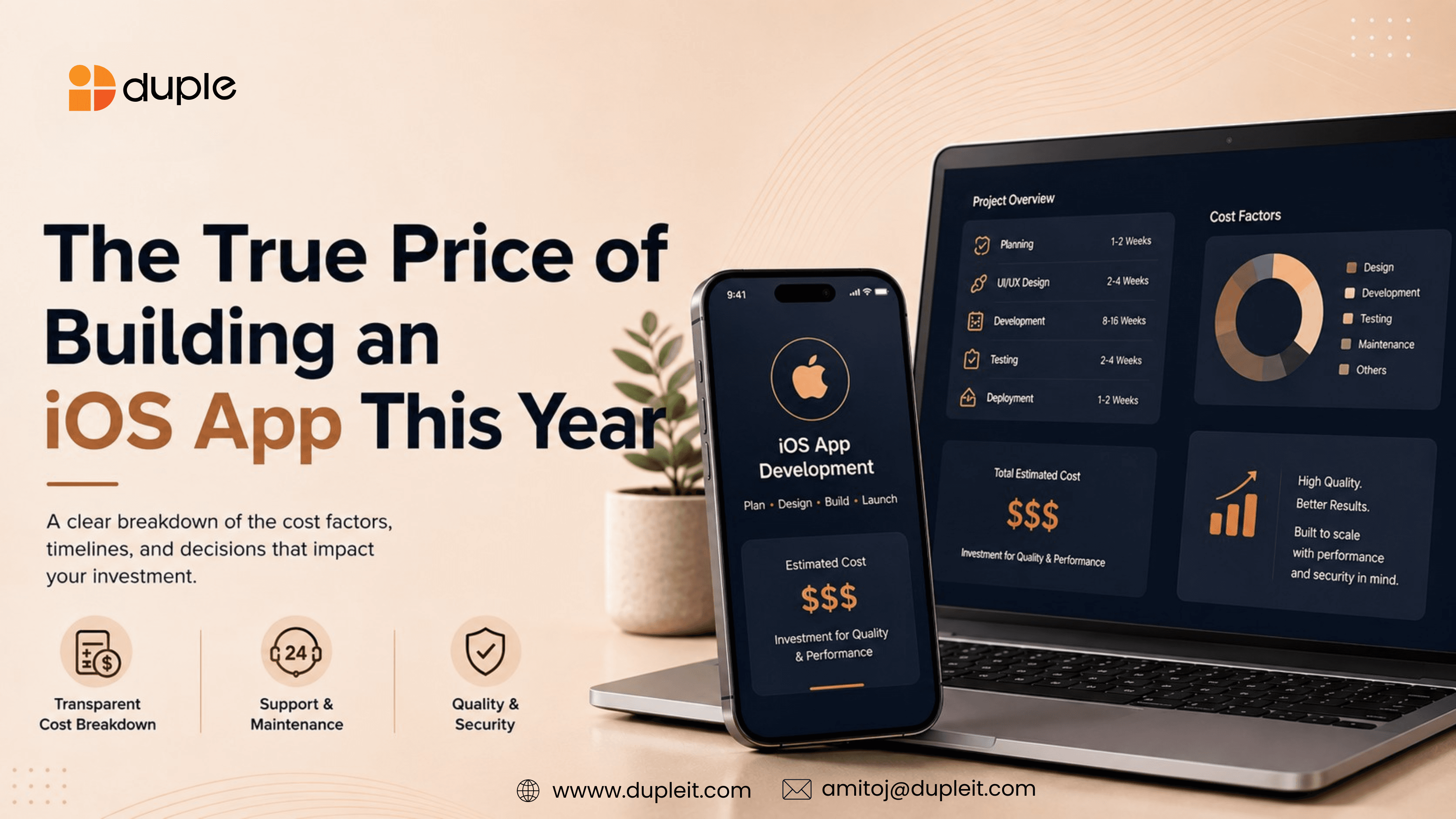
If you are planning an iOS app in 2026, you want a straight answer on cost before you commit. Fair enough. So here it is upfront: most iOS apps cost between $20,000 and $250,000 to build, depending on complexity.
But that range only tells half the story. The build price is the part everyone quotes. The true price includes the things that quietly add up after, Apple's rules, ongoing fees, maintenance, and the cost of decisions you make early without realizing their weight.
This guide covers both halves: what an iOS app actually costs to build, and the real costs most people don't budget for until they hit them.
- Note: All figures below are approximate market ranges and should be verified with current vendor quotes before you finalize a budget.
What Drives the Cost of an iOS App?
No two apps cost the same, because no two apps do the same work. Still, the price comes down to a handful of factors:
- App complexity: the number of features and how they connect. A simple utility is cheap. A social or fintech app is not.
- Design: basic layouts cost less; custom animations and polished branding cost more.
- Backend: apps that store data, handle logins, or process payments need servers behind them.
- Integrations: maps, payments, chat, and analytics each add work.
- Who builds it: a freelancer, an agency, and a large firm charge very differently.
- Where the team is located: rates in North America differ sharply from South Asia or Eastern Europe.
Almost every number below traces back to one of these.
iOS App Cost by Complexity
The clearest way to estimate is by app type. Here's a rough breakdown.
| App Type | Example | Estimated Cost | Timeline |
|---|---|---|---|
| Simple app | Single-purpose tool, basic UI, little backend | $20,000 – $50,000 | 2 - 4 months |
| Medium-complexity app | E-commerce, booking, social features | $50,000 – $120,000 | 4 - 8 months |
| Complex app | Fintech, on-demand marketplace, real-time features | $120,000 – $250,000+ | 8 - 12+ months |
Approximate ranges that vary by region and vendor.
Simple Apps
A simple app does one or two things well: a calculator, a habit tracker, a company info app. Little backend, minimal design, few integrations. These launch fastest and cheapest.
Medium-Complexity Apps
This is where most business apps land. User accounts, a database, several integrations, and thoughtful design. The work adds up, but so does the potential revenue.
Complex Apps
Social platforms, banking apps, and on-demand marketplaces involve real-time features, heavy security, and constant scaling. Bigger team, longer timeline, serious budget, usually chasing a large market.
Why iOS Has Its Own Cost Quirks?
iOS isn't just "Android but on iPhone." A few things make its cost profile distinct, and they're worth understanding before you start.
The Apple Developer Program Fee
To publish on the App Store, you need an Apple Developer account, which costs $99 per year (not a one-time fee like Google Play's). It's small, but it recurs, and it's easy to forget in year-two budgeting.
App Store Review Is Stricter
Apple reviews every app before it goes live, and its guidelines are notoriously particular. Apps get rejected for reasons that surprise first-timers: privacy issues, incomplete information, using private APIs, or not offering enough value.
This matters for cost because a rejection means rework and delay. An experienced iOS team builds to Apple's guidelines from the start, which saves you expensive back-and-forth later. A cheaper team unfamiliar with the process can cost you more in resubmissions.
Device and Version Fragmentation Is Lower
Here's some good news. Unlike Android, where you test across hundreds of device types, iOS has far fewer devices and OS versions to support. That usually means less testing time, which can offset some of iOS's other costs.
Apple's Commission on Payments
If your app sells digital goods or subscriptions, Apple takes a commission on those in-app purchases, commonly 15% to 30% depending on your situation. This isn't a build cost, but it directly affects your revenue math, so factor it into your business plan from day one. (Verify current rates and eligibility, as Apple's terms change.)
Native vs. Cross-Platform: Does It Change the Cost?
You'll face this decision early, and it affects your budget.
- Native iOS apps are built specifically for iOS using Swift. They perform beautifully and use every device feature, but only run on iOS.
- Cross-platform apps, built with Flutter or React Native, run on both iOS and Android from one codebase.
If you plan to launch on both platforms, cross-platform can save real money because you build once instead of twice. For apps that demand top performance or deep hardware access, native still wins.
For an iOS-only launch, native Swift is often the cleanest path.
Where Does Your Money Actually Go?
A common myth is that the whole budget goes to coding. It doesn't. Here's how a typical iOS project splits:
- Development (front-end and back-end): 40% to 50%
- UI/UX design: 15% to 20%
- Project management: 10% to 15%
- Quality assurance and testing: 10% to 15%
- Deployment and post-launch support: 5% to 10%
Design, testing, and management together take nearly half. That's not waste. iOS users have high expectations, and Apple's review rewards polish. Cutting corners here shows.
Development Cost by Hiring Option
Who you hire changes the price more than almost anything else.
Freelancers
You might pay $25 to $70 per hour for a skilled iOS developer, depending on location and experience. Low cost and flexibility, but one person can't cover design, backend, testing, and project management alone. For anything beyond a simple app, coordinating several freelancers becomes your job.
In-House Teams
Full control and long-term ownership, but salaries, benefits, and overhead make this the most expensive route. Only worth it if app development is core to your business for years to come.
Development Agencies
The most popular choice for serious projects. You get a full team, designers, developers, testers, a project manager, working together. Rates vary widely by region:
| Region | Approximate Hourly Rate |
|---|---|
| North America | $100 - $250 |
| Western Europe | $80 - $200 |
| Eastern Europe | $40 - $90 |
| South Asia (India) | $25 - $60 |
Approximate rates that shift over time.
This is why many companies in the US, UK, Canada, and Australia partner with agencies in regions like India, experienced teams at a fraction of local rates, without the hassle of managing individuals.
The Costs People Forget
The build price is not the finish line. Budget for these from day one:
- Apple Developer Program: $99 per year, ongoing.
- Servers and hosting: monthly cloud costs that grow with your users.
- Maintenance and updates: plan for roughly 15% to 20% of the build cost per year. iOS releases a major update annually, and your app needs to keep up or risk breaking.
- Third-party service fees: payment, SMS, maps, and push services often charge by usage.
- Marketing: an app nobody knows about earns nothing.
That maintenance line is especially real on iOS. When Apple ships a new iOS version each year, apps that don't adapt can look broken or get flagged. Ongoing upkeep isn't optional.
How to Reduce iOS App Development Costs?
You can build a great iOS app without overspending.
- Start with an MVP. Build only your core feature first, launch, learn from real users, then add what they actually want. This avoids paying for features nobody uses.
- Prioritize ruthlessly. List every feature you dream of, then cut it in half. The rest can wait for version two.
- Use existing tools. Ready-made services for logins, payments, and notifications save weeks of custom work.
- Build to Apple's guidelines from day one. This avoids costly rejections and resubmissions.
- Choose the right partner, not the cheapest. A low rate that produces code Apple rejects costs more in the end. Look for value and iOS experience.
A Realistic Budget Example
Say you want a medium-complexity fitness app for iOS, built with an experienced offshore agency:
- Design: $10,000
- Front-end and back-end development: $42,000
- Integrations (payments, health data, maps): $7,000
- Testing and QA: $8,000
- Project management: $6,000
- Estimated total: around $73,000
Add hosting, the Apple fee, and first-year maintenance, and budget another $12,000 to $15,000 in year one. These numbers are illustrative, but they show how the pieces fit.
Frequently Asked Questions
Ques 1: How much does it cost to build a basic iOS app in 2026?
A basic iOS app with limited features usually costs between $20,000 and $50,000. The final price depends on design, backend needs, integrations, and who builds it.
Ques 2: Is it more expensive to build an iOS app than an Android app?
The build costs are broadly similar. iOS can be slightly cheaper to test because there are fewer devices and OS versions, but Apple's stricter review and $99 annual fee add their own considerations. The bigger cost driver is complexity, not platform.
Ques 3: How long does it take to build an iOS app?
A simple app takes about 2 to 4 months. A medium app takes 4 to 8 months, and a complex app can take a year or more, depending on features and integrations.
Ques 4: What ongoing costs should I expect after launching an iOS app?
Plan for the $99 annual Apple Developer fee, hosting, maintenance (around 15% to 20% of build cost per year), third-party service fees, and marketing. iOS's yearly major updates make ongoing maintenance especially important.
Ques 5: Should I build native or cross-platform for iOS?
If you're launching on iOS only and need top performance, native Swift is often the cleanest choice. If you plan to launch on both iOS and Android, cross-platform tools like Flutter or React Native can save money by sharing one codebase.
Final Thoughts
The true price of an iOS app isn't just the number on the build quote. It's the build plus Apple's fees, the review process, ongoing maintenance, and the business math of Apple's commission if you sell through the app.
None of that should scare you off. iOS users tend to spend more and engage more, which is exactly why the platform is worth the investment. The key is going in with the full picture, not just the build price.
Get a clear scope, start with an MVP, choose a partner who knows Apple's process, and budget for the costs that come after launch. Do that, and your iOS app becomes an investment with a clear return rather than a surprise bill.
It's time to turn your iOS idea into reality
Talk to the team at Duple IT Solutions for a free consultation and a tailored quote. Let's build something worth downloading.
Need help with this?
We help businesses implement what we write about. Book a free call to discuss your specific situation.


