
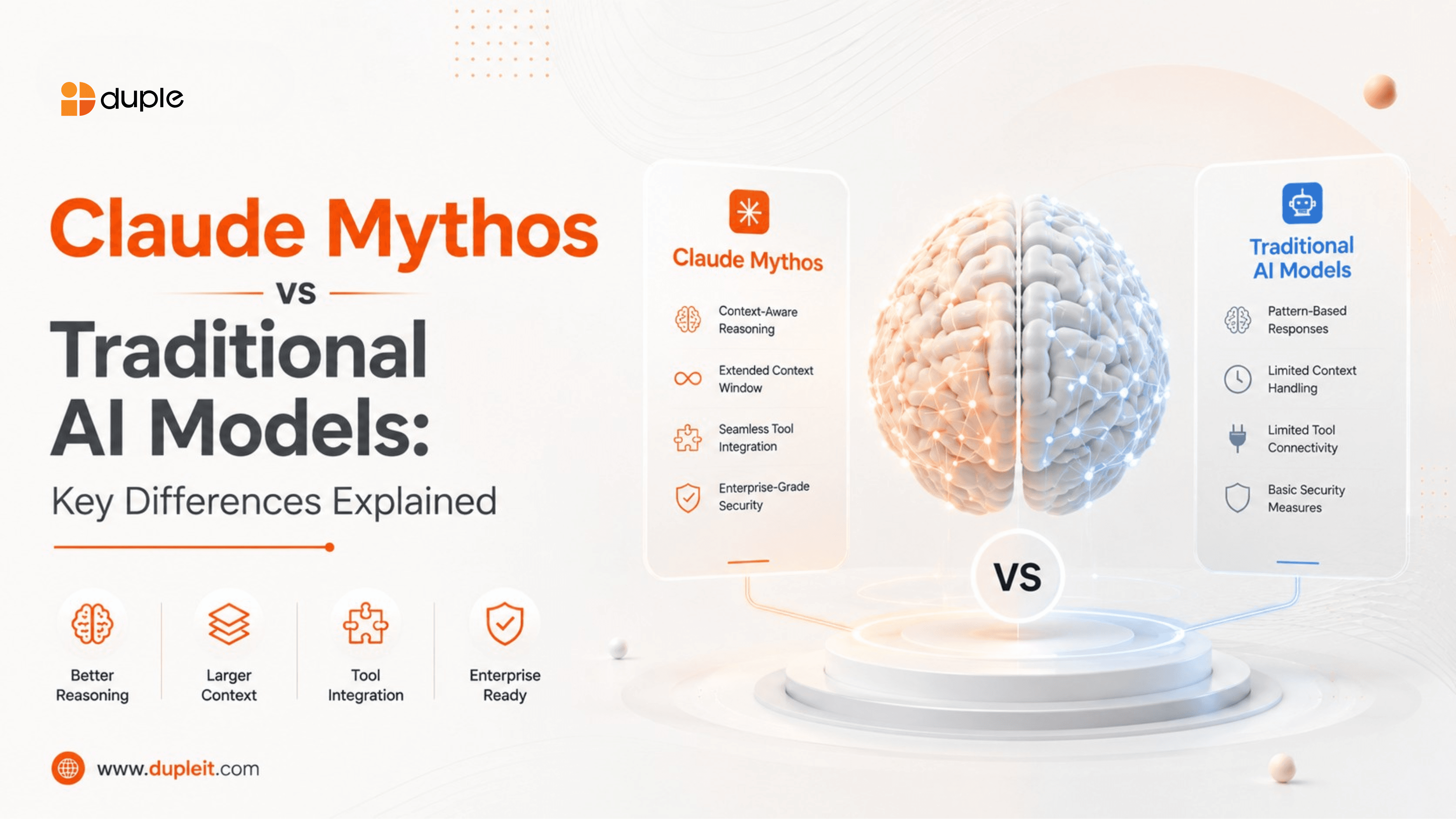
A new class of AI model arrived in 2026, and it's worth understanding what it actually changes for you, not just the hype around it.
Anthropic introduced Claude Mythos, a model tier that sits above its previous top model, Opus. It made headlines partly for its capabilities and partly because Anthropic decided it was powerful enough that the first version, Claude Mythos Preview, wasn't released to the general public at all.
If you run a business or are planning to build software, you've probably seen the term and wondered: is this just marketing, or does it actually matter for what I'm building?
This guide answers that in plain terms. We'll cover what Mythos-class models are, how they differ from the AI models most tools use today, and, most importantly, what it all means for your product and your budget.
Note: The AI landscape moves fast, and details below may have changed since writing. Verify current model availability, pricing, and capabilities on Anthropic's official site before making decisions.
First, What Do We Mean by "Traditional AI Models"?
Let's set a baseline, because "traditional AI" is a fuzzy phrase.
For this discussion, traditional AI models are the widely available large language models that power most AI features today. Think of the standard tiers most products are built on: fast, affordable models for simple tasks, and more capable mid-to-high tier models for harder reasoning.
In Anthropic's lineup, that has meant models in the Haiku, Sonnet, and Opus families. Similar tiers exist across other providers. These models handle the vast majority of real-world business needs: chatbots, content generation, summarization, coding help, data extraction, and customer support.
They're capable, well understood, affordable, and available to everyone. For most products, they are more than enough.
Keep that last point in mind. It matters more than the rest of this article.
What Is Claude Mythos?
Claude Mythos is a model tier that sits above Opus, representing a step up in capability. Anthropic announced it in April 2026 and described it as a significant jump beyond its previous models.
Here's the unusual part. The first model in this tier, Claude Mythos Preview, was not released to the public. Anthropic judged it capable enough in sensitive areas, particularly offensive cybersecurity, that broad release without new safeguards would be risky. Access was instead limited to a small number of vetted organizations through a controlled program.
Later, in June 2026, Anthropic released the first Mythos-class model to a wider audience: Claude Fable 5. This shares the underlying power of the Mythos tier but ships with additional safeguards in high-risk areas like cybersecurity and biology, which made a broader release possible for enterprise and paid users.
So the picture is layered:
- Mythos-tier = the capability class above Opus
- Claude Mythos Preview = the first, restricted-access version
- Claude Fable 5 = the first broadly available Mythos-class model, with safeguards
(These specifics evolve. Check Anthropic's official announcements for the current state.)
Mythos-Class vs Traditional Models: The Real Differences
Now the practical part. Here's how a frontier tier like Mythos actually differs from the standard models most businesses use.
| Factor | Traditional Models (Haiku/Sonnet/Opus tier) | Mythos-Class Models |
|---|---|---|
| Capability | Strong across everyday business tasks | A step above, especially on the hardest reasoning and technical problems |
| Availability | Widely available to everyone | More gated; the most capable versions are restricted or safeguarded |
| Cost | Lower, predictable per-token pricing | Higher, positioned as a premium/specialty tier |
| Best for | The vast majority of real products | Specialized, high-stakes, or frontier work |
| Access model | Standard API and apps | Verification and safeguards may apply |
The headline: a Mythos-class model isn't simply "a better version of the same thing you'd use anyway." It's positioned as a specialty tool for the hardest problems, not a drop-in replacement for everyday work.
Capability
The main draw is performance on genuinely hard problems: complex, multi-step reasoning, difficult coding and debugging, and deep technical analysis. On the toughest tasks, the gap over previous models can be large.
For routine tasks, though, the difference is far less noticeable. A model summarizing an email or answering a support question doesn't need frontier-level reasoning. Both a standard model and a frontier model will do it well.
Cost
Frontier capability comes at a premium. Mythos-tier models are priced well above standard models. That changes the math: at those rates, a frontier model is not a default choice you run on everything. It's a tool you reach for when the value of solving one hard problem justifies the cost.
Availability and Safeguards
This is a real difference from traditional models. The most capable frontier models may come with access restrictions, verification steps, or safeguards that standard models don't have. If you're building on them, that can affect what your product is allowed to do and who can use certain features.
What This Actually Means for Your Business
Here's the part that matters most, and it may be the opposite of what the hype suggests.
For most businesses and most products, standard models are still the right choice.
That's not a hedge. It's the honest answer. The overwhelming majority of AI features, chatbots, content tools, support automation, data processing, coding assistance, run beautifully on widely available models at a fraction of frontier pricing.
Reaching for a frontier model when a standard one would do is like renting a race car for the daily commute. Impressive, expensive, and pointless for the actual job.
So when does a frontier tier genuinely earn its cost? A few situations:
- Genuinely hard technical problems where a standard model falls short and the correct answer is worth a lot.
- High-stakes work where a single missed detail is expensive, and frontier accuracy pays for itself.
- Frontier research or specialized security work, which is exactly where these models are aimed.
- A specific capability gap, where you've tested a standard model, hit a real wall, and confirmed the harder model clears it.
Notice the pattern. You start with the standard model, and you only move up when you've hit a real limit. Not before.
A Practical Way to Decide
If you're building an AI feature, here's a sensible approach:
- Start with a capable standard model. For most needs, this is your answer, full stop.
- Build and test with real tasks. See whether it actually meets your quality bar.
- Identify specific failures. If it falls short, pinpoint exactly where and why.
- Test a higher tier only on those cases. Confirm the upgrade genuinely fixes the problem.
- Compare the value against the cost. Does solving that case justify the premium?
This keeps you from overspending on capability you don't need, while leaving the door open for the cases where it truly helps.
Why This Shift Matters Even If You Don't Use Frontier Models
Even if you never touch a Mythos-class model, this development tells you something useful about where AI is heading.
Capability is increasingly tied to safety controls. The fact that Anthropic held back its most capable model, then released a safeguarded version, signals a future where the most powerful AI comes with more rules, verification, and restrictions. If you build on frontier models, expect tighter usage policies over time.
The gap between "good enough" and "frontier" is widening. Standard models keep getting better and cheaper, which is great for most businesses. Meanwhile, frontier models push into territory that's genuinely specialized. For you, that mostly means the affordable models you rely on keep improving.
Choosing the right model is now a real skill. As the range of options grows, matching the model to the task, and the budget, becomes part of building good software. That's exactly the kind of decision a good development partner should help you make.
Frequently Asked Questions
Ques 1: What is Claude Mythos?
- Claude Mythos is a model tier from Anthropic that sits above its Opus models, announced in April 2026. The first version, Mythos Preview, was restricted rather than released publicly. The first broadly available Mythos-class model, Claude Fable 5, launched in June 2026 with added safeguards.
Ques 2: How is a Mythos-class model different from regular AI models?
- It's positioned as a step up in capability for the hardest reasoning and technical tasks, at a higher cost and with more access controls. Regular models remain widely available, cheaper, and more than capable for most everyday business tasks.
Ques 3: Should my business use a frontier AI model?
- Usually not by default. Standard, widely available models handle the vast majority of business needs at much lower cost. Consider a frontier model only when you've tested a standard one, hit a real limit, and confirmed the harder problem justifies the premium.
Ques 4: Why didn't Anthropic release Claude Mythos Preview publicly?
- Anthropic judged it capable enough in sensitive areas, especially offensive cybersecurity, that a broad release without new safeguards posed real risk. It limited access to vetted organizations, then later released a safeguarded Mythos-class model, Claude Fable 5, more widely.
Ques 5: Does this affect the cost of building an AI product?
- It can, but often in a good way. Standard models keep improving and staying affordable, which covers most products. You'd only face frontier-tier pricing if your specific use case genuinely requires that level of capability, which most don't.
Final Thoughts
The arrival of Mythos-class models is a real milestone, but the most useful takeaway for your business is calmer than the headlines.
Frontier models matter for the hardest, highest-stakes problems. For almost everything else, the standard models you already have access to are capable, affordable, and improving fast. The skill isn't chasing the most powerful model. It's matching the right model to the job and the budget.
Start with what's proven and affordable. Move up only when a real limitation forces the decision. That approach keeps your product strong and your spending sensible, no matter how fast the frontier moves.
Want help figuring out which AI models fit your product and budget?
Talk to the team at Duple IT Solutions for a free consultation. We'll help you choose the right approach, build with the models that fit your actual needs, and avoid paying for capability you don't require.
Need help with this?
We help businesses implement what we write about. Book a free call to discuss your specific situation.


