
You have an app idea. You're excited, and you want to start building right now. But before you spend a single rupee or dollar on development, there's a decision that will shape your whole journey: should you start with a PoC, a prototype, or an MVP?
These three terms get thrown around a lot, and people often use them as if they mean the same thing. They don't. Each one answers a different question, costs a different amount, and fits a different stage of your idea.
Pick the wrong one, and you can waste months of work and a big chunk of your budget. Pick the right one, and you save money, learn faster, and build something people actually want.
So let's clear up the confusion. By the end of this guide, you'll know exactly which one your startup needs and why.
The Short Answer First
Here's the quickest way to understand the difference:
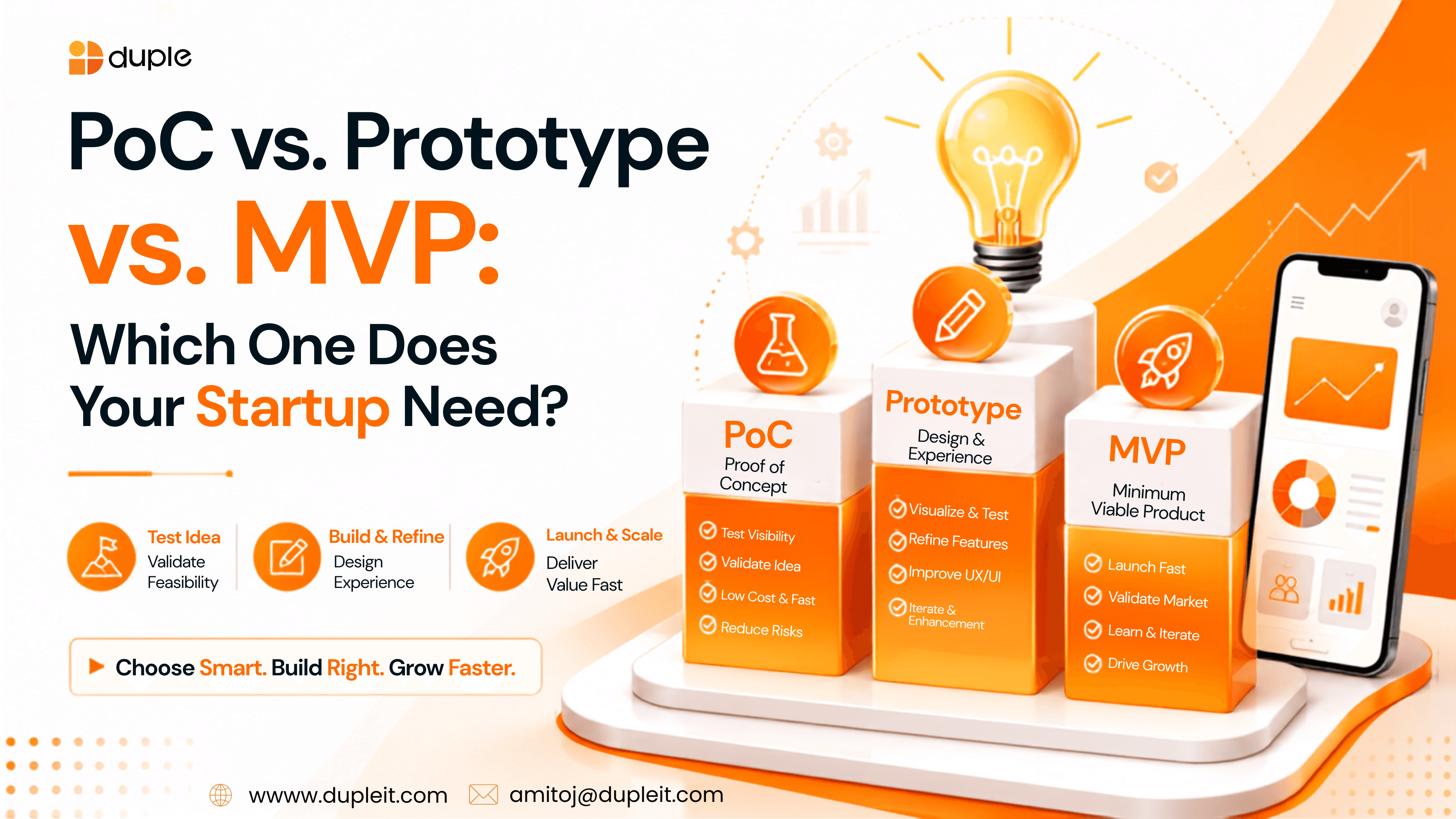
- A Proof of Concept (PoC) answers: "Can we build this?"
- A Prototype answers: "How will it look and feel?"
- An MVP answers: "Will people actually use and pay for this?"
Think of it like building a house. A PoC tests whether the ground can hold the structure. A prototype is the 3D model you walk clients through. An MVP is a small, livable house you move into and improve over time.
Now let's break each one down properly.
What Is a Proof of Concept (PoC)?
A Proof of Concept is a small experiment. Its only job is to check whether your idea is technically possible.
You're not building a full app here. You're not worrying about design or users. You're simply answering one question: can this actually be done?
For example, say you want to build an app that detects a plant disease from a photo. Before building the whole app, you'd create a PoC to test just one thing: can the AI model correctly identify diseases from images? If it works, great, you move forward. If it doesn't, you've saved yourself from building an app around a feature that was never going to work.
When You Need a PoC
A PoC makes sense when:
- Your app relies on new or unproven technology.
- You're using AI, machine learning, or complex integrations.
- You need to convince technical stakeholders or investors that the idea is feasible.
- You're unsure whether a key feature can be built at all.
What a PoC Is Not
A PoC is not something you show to customers. It's usually rough, internal, and built fast. Nobody cares if it looks ugly, because its only purpose is to prove the concept works.
What Is a Prototype?
A prototype is all about look and feel. It shows how your app will work from the user's point of view, without the working code behind it.
Think of it as an interactive mockup. Users can tap buttons, move between screens, and get a real sense of the experience, but nothing is actually functional under the hood. There's no real database, no live features, just the visual flow.
Prototypes are usually built with design tools like Figma or Adobe XD. They're quick to make and easy to change.
When You Need a Prototype
A prototype is the right choice when:
- You want to test the user experience before development.
- You need to pitch your idea to investors with something visual.
- You want early feedback on design and flow.
- You're deciding between different layouts or features.
The Big Benefit
A prototype lets you fix problems early, when changes are cheap. Moving a button in Figma takes minutes. Moving it after the app is coded takes hours and money. Testing your design first saves you from expensive mistakes later.
What Is an MVP?
An MVP, or Minimum Viable Product, is a real, working app, just stripped down to its core. It includes only the essential features needed to solve your users' main problem, and nothing extra.
Unlike a PoC or prototype, an MVP is something you actually launch. Real users download it, use it, and give feedback. That feedback then guides what you build next.
A famous example is Airbnb. The founders didn't build a huge platform at first. They started by renting out air mattresses in their own apartment through a simple website. That small, working version proved people would pay to stay in strangers' homes. Everything else grew from there.
When You Need an MVP
An MVP is right when:
- You're ready to launch and get real users.
- You want to test demand in the actual market.
- You need to attract investors with real usage data.
- You want to start earning revenue while you improve.
The Core Idea
The word "minimum" trips people up. An MVP is not a half-broken app. It's a complete experience for one core problem. It does one thing well, then grows based on what real users want.
PoC vs. Prototype vs. MVP: A Side-by-Side Comparison
Sometimes a table makes everything click. Here's how the three stack up:
| Factor | Proof of Concept | Prototype | MVP |
|---|---|---|---|
| Main question | Can we build it? | How will it look and feel? | Will people use it? |
| Purpose | Test feasibility | Test design and flow | Test the market |
| Audience | Internal team, tech stakeholders | Investors, test users | Real customers |
| Functionality | One feature, rough | Clickable, not functional | Fully working, core features |
| Cost | Low | Low to medium | Medium to high |
| Time | Days to a few weeks | 1 – 4 weeks | 2 – 6 months |
| Outcome | Proof it works | Visual model | Launched product |
Cost and time ranges are approximate and vary by project.
How They Work Together
Here's something many first-time founders miss: these three aren't rivals. They're often steps in the same journey.
A typical path looks like this:
- Start with a PoC if your idea depends on risky or unproven tech. Confirm it can be built.
- Move to a prototype to design the experience and gather feedback on look and flow.
- Build an MVP to launch, get real users, and start learning from the market.
That said, you won't always need all three. A simple app with proven technology might skip the PoC entirely and go straight to a prototype or MVP. The key is to match the tool to your specific risk.
Ask yourself: what's the biggest unknown right now?
- If the unknown is technical, start with a PoC.
- If the unknown is the experience or design, start with a prototype.
- If the unknown is whether people want it, build an MVP.
Which One Does Your Startup Actually Need?
Let's make this practical. Here are a few common situations and the right starting point for each.
Situation 1: "I have an AI-powered idea and I'm not sure it's even possible." Start with a PoC. Prove the core technology works before anything else.
Situation 2: "I know the tech works, but I need to show investors my vision." Build a prototype. A clickable design tells a far better story than a slide deck.
Situation 3: "I'm confident in my idea and I want to test it in the real market." Go with an MVP. Launch small, learn fast, and grow from real feedback.
Situation 4: "I have a tricky feature, need funding, and want to launch soon." You may need all three, in order. PoC to prove the feature, prototype to raise money, MVP to launch.
There's no single right answer. The best choice depends on your biggest risk, your budget, and how ready your idea is.
Common Mistakes to Avoid
Even smart founders slip up here. Watch out for these traps:
- Building the full app right away. Skipping these stages feels faster but often leads to expensive rework. Test first, build big later.
- Confusing an MVP with a rough draft. An MVP should feel complete for its core purpose, even if it's small. A buggy, half-finished app drives users away.
- Adding too many features. The whole point is to stay lean. Every extra feature adds cost and delays your learning.
- Skipping user feedback. These stages exist to help you learn. If you don't listen to feedback, you miss the point entirely.
- Never moving forward. Some teams get stuck perfecting a prototype forever. Set a goal, hit it, then take the next step.
Frequently Asked Questions
What is the main difference between a PoC, prototype, and MVP?
A PoC tests whether an idea is technically possible. A prototype shows how the app will look and feel. An MVP is a working product with core features that you launch to real users. Each answers a different question at a different stage.
Do I need all three for my startup?
Not always. If your technology is already proven, you can skip the PoC. Simple apps might go straight to a prototype or MVP. Choose based on your biggest unknown, whether that's technical, design, or market demand.
Which is cheaper: a prototype or an MVP?
A prototype is usually cheaper because it has no working code behind it. It's just an interactive design. An MVP is a real, functional app, so it costs more and takes longer to build.
How long does it take to build an MVP?
Most MVPs take around 2 to 6 months, depending on complexity. Focusing on only the core features keeps the timeline short and the cost manageable.
Should I show my PoC to investors?
Usually not. A PoC is a rough, internal experiment. For investors, a polished prototype or a working MVP tells a much stronger story and shows real progress.
Final Thoughts
Choosing between a PoC, a prototype, and an MVP isn't about picking the "best" one. It's about picking the right one for where you are today.
If your biggest question is can it be built, start with a PoC. If it's how will it feel, build a prototype. And if it's will people use it, go straight for an MVP.
The smartest founders don't build everything at once. They test the riskiest part first, learn from it, and move forward one clear step at a time. That approach saves money, reduces risk, and gets you to a product people love much faster.
Not sure which stage fits your idea? Talk to the team at Duple IT Solutions for a free consultation. We'll help you choose the right approach and turn your idea into a real, working product, without wasting your budget on the wrong path.
Need help with this?
We help businesses implement what we write about. Book a free call to discuss your specific situation.


