
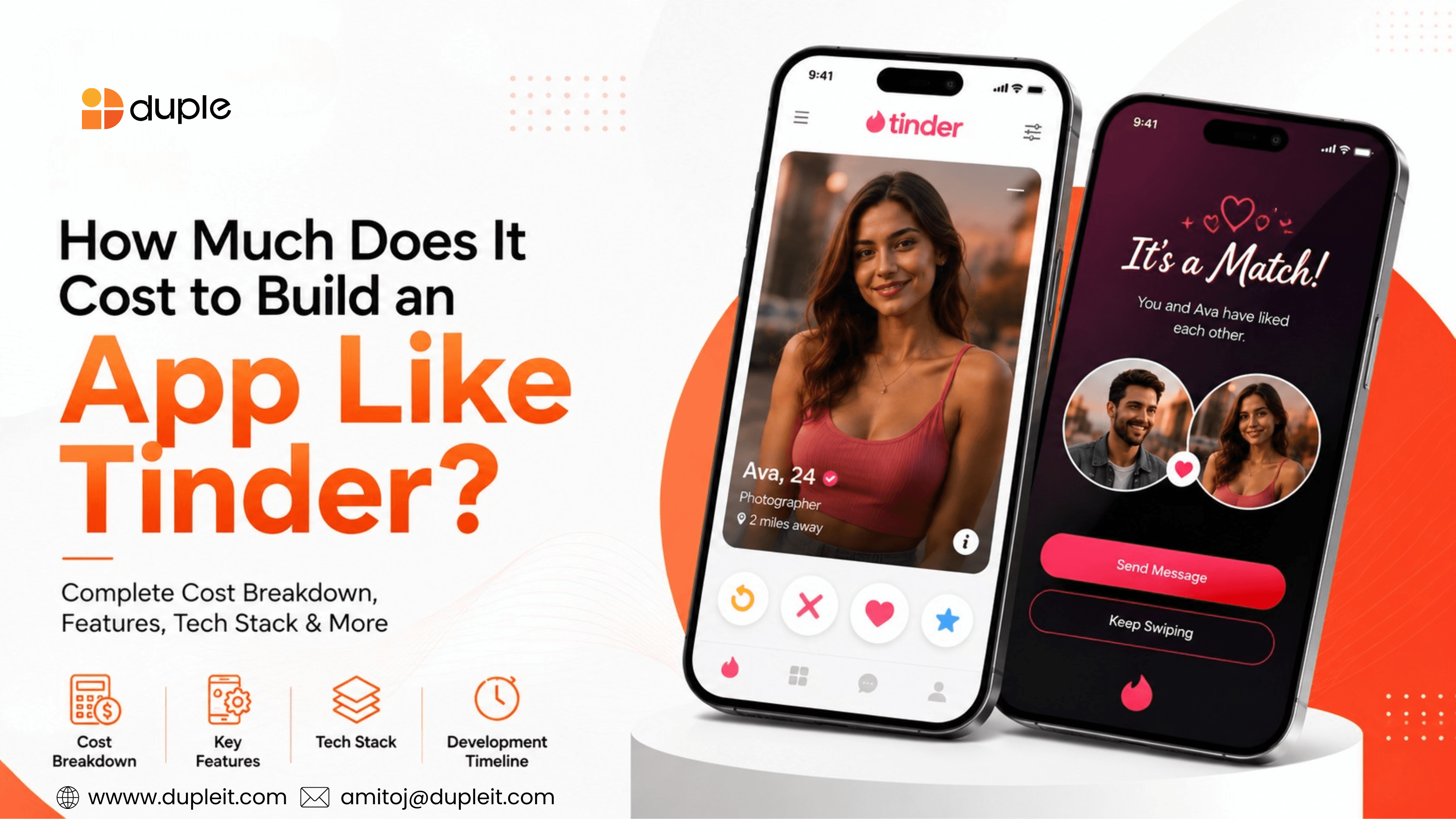
If you're planning a dating or matching app, you want a real number, not a vague "it depends." So here it is: building an app like Tinder typically costs between $30,000 and $250,000, depending on where it's built and how much you include at launch.
That's a wide range, and the reason is simple. The famous swipe mechanic is actually cheap to build. What makes budgets balloon is everything around it: safety infrastructure, identity verification, a matching algorithm that works at scale, and the payment system that makes the whole thing a business.
This guide breaks the cost down feature by feature, honestly. It also covers something most agency posts skip: whether you should build a Tinder clone at all, because for a general audience in 2026, that's often the wrong move.
Note: All figures below are approximate market ranges and should be verified with current vendor quotes before you budget.
The Short Answer, by Build Type
Here's the quick version before we go deeper.
| Version | What's Included | Estimated Cost (India rates) | Estimated Cost (US/EU rates) |
|---|---|---|---|
| Basic MVP | Swipe, match, chat, profiles, geolocation | $30,000 – $50,000 | $60,000 – $120,000 |
| Mid-tier | Above + video calls, AI matching, subscriptions | $50,000 – $90,000 | $120,000 – $180,000 |
| Full platform | Above + advanced safety, verification, moderation, scale | $90,000 – $150,000+ | $180,000 – $300,000+ |
Approximate ranges. The gap between regions comes mostly from hourly rates, not scope or quality.
Notice the difference between columns. A team in India or Eastern Europe often charges $25 to $60 per hour, while a US or Western European agency charges $100 to $250. For the same app, that's the difference between $50,000 and $150,000, with no drop in quality when you pick the right partner. This is why so many founders build offshore.
Where the Money Actually Goes?
Here's the honest breakdown that most quotes hide. The core features everyone talks about are the cheap part.
- Swipe mechanic: the famous left/right swipe is surprisingly inexpensive to build.
- Basic matching logic: connecting two people who both swiped right isn't complex.
- Real-time chat: more involved, but a well-trodden path.
So what makes a dating app expensive? These:
- Identity verification: photo and document checks to stop fake profiles and catfishing.
- Safety and moderation: reporting, blocking, content moderation, and abuse prevention. This is non-negotiable for a dating app and it's substantial work.
- A matching algorithm that works at scale: a basic version is cheap; a smart, learning one that keeps users engaged is a real investment.
- Subscription and payment billing: the system that actually makes you money, with tiers, in-app purchases, and store compliance.
The lesson: don't let a cheap quote fool you. If someone offers to build "an app like Tinder" for a suspiciously low price, ask what safety and verification work is included. Usually, that's exactly what's been left out, and it's the most expensive thing to add later.
Feature-by-Feature: What You're Paying For
Let's look at the pieces that make up a dating app, roughly from essential to advanced.
The Must-Haves (Your MVP)
These are non-negotiable for a working dating app:
- User onboarding and authentication: social logins (Google, Apple), plus phone verification to keep bots out.
- Profile creation: photos, short bio, interests, and increasingly short video clips.
- Geolocation: showing nearby matches without draining the battery, which is a real engineering balance.
- Swipe and match logic: the core interaction.
- Real-time chat: instant messaging between matches, usually built on websockets.
- Push notifications: the hook that brings users back for new matches and messages.
Build these well and you have a functioning MVP. Everything below is an upgrade.
The Value-Adds (Mid-Tier)
Once the core works, these features raise engagement and open revenue:
- AI-driven matching: algorithms that learn preferences over time and improve match quality.
- Video dating: in-app video calls, now an expected feature rather than a luxury.
- Premium features: things like Rewind, Passport (browsing other locations), and Super Likes.
- Subscriptions: the freemium model that funds the business.
The Trust Layer (Full Platform)
This is what separates a serious platform from a risky one:
- Identity verification: AI-powered photo or document checks that build user trust.
- Advanced content moderation: automated and human review to keep the platform safe.
- Fraud and fake-profile detection: catching bad actors before they harm real users.
- Analytics and A/B testing: to keep improving match rates and retention.
The Honest Conversation: Should You Even Build a Tinder Clone?
Here's something most agency blogs won't tell you, because they want the contract.
Building a general dating app to compete directly with Tinder, Bumble, and Hinge is usually a bad business idea in 2026.
Not because it's technically hard. It isn't. The problem is the cold-start problem. Those platforms have hundreds of millions of profiles. A new dating app in a general market shows early users almost no nearby matches, so they leave before they get any value. Then the next users see even fewer people. It's a chicken-and-egg trap that has killed countless well-built dating apps.
So where's the opportunity? Niche and non-dating matching.
The Tinder model, swipe, match, connect, works brilliantly for focused communities and entirely different use cases:
- A niche dating app for a specific community, interest, or location where you can actually reach density.
- A co-founder matching platform for a startup community or accelerator.
- A mentorship platform connecting mentors and mentees.
- A professional networking or study-partner app.
In these cases, you're not fighting Tinder's hundreds of millions of users. You're solving a real matching problem for a defined group, where reaching a critical mass of users is actually possible.
The swipe interface is a great metaphor. The general dating market is a brutal place to use it. Think carefully about which one you're really building.
Ongoing and Hidden Costs
The build price is just the start. Budget for these too:
- App store fees: $99/year for Apple, $25 one-time for Google Play.
- Servers and hosting: grows with your user base; real-time chat and video are demanding.
- Third-party services: SMS verification, email, video infrastructure, and maps, often charged by usage.
- Content moderation: if you use human moderators or a moderation service, this is an ongoing operational cost, not a one-time build.
- Maintenance: plan for roughly 15% to 20% of build cost per year.
And the big one that founders consistently underestimate:
- Marketing and user acquisition: for a dating app, this often costs more than the app itself. An app with no users is just a fancy calculator, no matter how good the matching algorithm. Set aside a serious budget to actually get people on the platform.
How Dating Apps Make Money?
Since the payment system is a core cost, it helps to know how you'll earn it back. The common models:
- Freemium subscriptions: free basic swiping, paid tiers for unlimited swipes, seeing who liked you, and boosts. This is the dominant model.
- In-app purchases: one-time buys like profile boosts or Super Likes.
- Premium tiers: multiple subscription levels at increasing prices.
Build your monetization plan early, because it shapes what you build. The billing system isn't an afterthought; it's the engine of the business.
How to Keep Costs Under Control?
You can build a strong matching app without overspending:
Start with a true MVP. Core features only: swipe, match, chat, profiles, location. Launch, learn, then add.
Pick a niche where you can win. This isn't just business advice; it's cost advice. A focused app needs fewer features and less marketing spend to reach critical mass.
Choose the right region and partner. Offshore agencies deliver the same quality at a fraction of US rates. Vet them properly, but don't overpay out of habit.
Avoid clone scripts for anything serious. Cheap pre-built dating scripts exist, but they rarely handle real traffic, real safety needs, or a niche's specific requirements. They usually cost more to fix than to replace.
Don't skip safety to save money. It's tempting, but safety failures can destroy a dating app's reputation overnight. This is the one place not to cut corners.
Frequently Asked Questions
Ques 1: How much does it cost to build an app like Tinder?
A basic MVP with swipe, match, chat, and geolocation typically costs $30,000 to $50,000 at offshore rates, or $60,000 to $120,000 at US/EU rates. A full-featured platform with AI matching and advanced safety can exceed $150,000. The region you build in is the biggest single cost factor.
Ques 2: Why is the swipe feature cheap but the app expensive?
The swipe mechanic and basic matching are simple to build. What drives cost is the safety infrastructure: identity verification, content moderation, fraud detection, a matching algorithm that works at scale, and a subscription billing system. These are the parts that make a dating app viable, and they're where budgets grow.
Ques 3: How long does it take to build a Tinder-like app?
A basic MVP usually takes 3 to 4 months. A mid-tier app with video and AI matching takes 5 to 7 months, and a full platform with advanced safety features can take 8 to 12 months, depending on scope.
Ques 4: Is it a good idea to build a dating app in 2026?
Competing head-on with Tinder in the general market is very hard due to the cold-start problem. However, niche dating apps and non-dating matching platforms (co-founder matching, mentorship, professional networking) are strong opportunities where the swipe model works well and reaching users is realistic.
Ques 5: How do apps like Tinder make money?
Most use a freemium model: free basic swiping, with paid subscriptions for premium features like unlimited swipes and seeing who liked you. They also earn through one-time in-app purchases like boosts and Super Likes, and often offer multiple subscription tiers.
Final Thoughts
The true cost of an app like Tinder isn't really about the swipe. It's about everything that makes a matching platform safe, engaging, and profitable: verification, moderation, smart matching, and billing. That's where your budget goes, and that's what a cheap quote leaves out.
But the most important decision comes before any of that. Not "how much does it cost," but "who is this really for?" A general dating clone fights an uphill battle against giants. A focused matching platform for a community that needs one has a genuine path to succeed.
Get the target right, start with a lean MVP, don't skimp on safety, and build with a partner who'll tell you the hard truths. That's how you turn a big idea into a real product without burning your budget.
Thinking about building a matching or dating app?
Talk to the team at Duple IT Solutions for a free consultation. We'll help you scope the right version, choose features that fit your budget, and build something that can actually find its users.
Need help with this?
We help businesses implement what we write about. Book a free call to discuss your specific situation.


